Tuesday, November 19, 2019

CITATION


  • First Law of Thermodynamics


  • Third Law of Thermodynamics


CORRECT ANSWERS

1.Suppose 40.00 J of energy is transferred by heat to a system, while the system does 10.00 J of work. Later, heat transfers 25.00 J out of the system, while 4.00 J is done by work on the system. What is the net change in the system’s internal energy?
    9J
2. What is the change in the internal energy of a system when a total of 150.00 J is transferred by heat from the system and 159.00 J is done by work on the system?
    9J
3. What is internal energy?
    It is the sum of the kinetic and potential energies of a system’s atoms and molecules.
4. It states that the entropy of a pure crystal at absolute zero is zero.
    Third Law of Thermodynamics
5. It states that heat transfer occurs spontaneously from higher- to lower-temperature bodies but never spontaneously in the reverse direction.
    Second Law of Thermodynamics
6.  Entropy in any closed system always increases; it never decreases.
7. In a system,it is a measure of disorder.
    Entropy
8. Heat transfer occurs spontaneously from a hot object to a cold one.
    True
9. ___________states that the change in internal energy of a system equals the net heat transfer into the system minus the net work done by the system.
    First Law of Thermodynamics
10. The absolute zero temperature is the _______ for determination entropy.
    Reference Point

Third Law of Thermodynamics


The Third Law states that the entropy of a pure crystal at absolute zero is zero. As explained, entropy is sometimes called "waste energy," i.e., energy that is unable to do work, and since there is no heat energy whatsoever at absolute zero, there can be no waste energy. Entropy is also a measure of the disorder in a system, and while a perfect crystal is by definition perfectly ordered, any positive value of temperature means there is motion within the crystal, which causes disorder. For these reasons, there can be no physical system with lower entropy, so entropy always has a positive value.
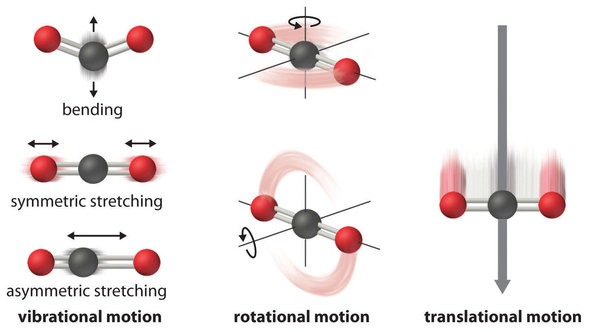
13.6.1.jpg
Figure 1.Molecular Motions. Vibrational, rotational, and translational motions of a carbon dioxide molecule are illustrated here. Only a perfectly ordered, crystalline substance at absolute zero would exhibit no molecular motion (classically; there will always be motion quantum mechanically) and have zero entropy. In practice, this is an unattainable ideal. Image used with permission (CC BY-SA-NC; anonymous).


The Third Law of Thermodynamics states that
  • the entropy of any pure substance in thermodynamic equilibrium approaches zero as the temperature approaches zero (Kelvin), or conversely
  • the temperature (Kelvin) of any pure substance in thermodynamic equilibrium approaches zero when the entropy approaches zero
The Third Law of Thermodynamics can mathematically be expressed as
lim ST→0 = 0                               (1)
where
S = entropy (J/K)
T = absolute temperature (K)
At temperature absolute zero there is no thermal energy or heat. At temperature zero Kelvin the atoms in a pure crystalline substance are aligned perfectly and do not move. There is no entropy of mixing since the substance is pure.
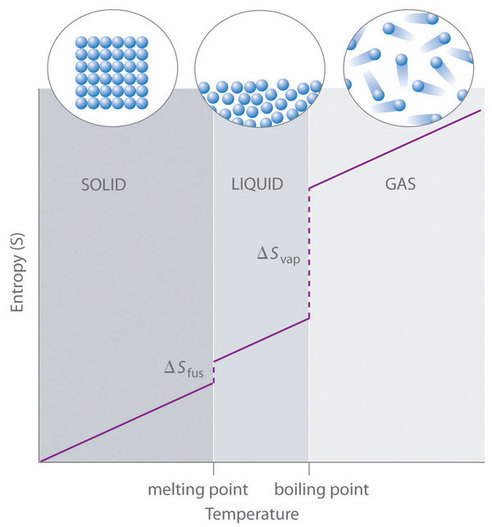
The absolute zero temperature is the reference point for determination entropy. Absolute entropy of a substance can be calculated from measured thermodynamic properties by integrating differential equations of state from absolute zero. For a gas this requires integrating through solid, liquid and gaseous phases.

151633896073916794.jpg
Figure 2. A Generalized Plot of Entropy versus Temperature for a Single Substance. Absolute entropy increases steadily with increasing temperature until the melting point is reached, where it jumps suddenly as the substance undergoes a phase change from a highly ordered solid to a disordered liquid (ΔSfus). The entropy again increases steadily with increasing temperature until the boiling point is reached, where it jumps suddenly as the liquid undergoes a phase change to a highly disordered gas (ΔSvap). Image used with permission (CC BY-SA-NC; anonymous).

Test Your Knowledge

1.Suppose 40.00 J of energy is transferred by heat to a system, while the system does 10.00 J of work. Later, heat transfers 25.00 J out of the system, while 4.00 J is done by work on the system. What is the net change in the system’s internal energy?
    15J
    6J
    9J
    21J
2. What is the change in the internal energy of a system when a total of 150.00 J is transferred by heat from the system and 159.00 J is done by work on the system?

    5J
    6J
    9J
3. What is internal energy?
    It is the sum of the kinetic energies of a system’s atoms and molecules.
    It is the sum of the potential energies of a system’s atoms and molecules.
    It is the sum of the kinetic and potential energies of a system’s atoms and molecules.
    It is the difference between the magnitudes of the kinetic and potential energies of a system’s atoms and molecules.
4. It states that the entropy of a pure crystal at absolute zero is zero.
    First Law of Thermodynamics
    Second Law of Thermodynamics
    Third Law of Thermodynamics
    Entropy
5. It states that heat transfer occurs spontaneously from higher- to lower-temperature bodies but never spontaneously in the reverse direction.
    First Law of Thermodynamics
    Second Law of Thermodynamics
    Third Law of Thermodynamics
    Entropy
6.  Entropy in any closed system always increases; it never decreases.

    False
7. In a system,it is a measure of disorder.
    First Law of Thermodynamics
    Second Law of Thermodynamics
    Third Law of Thermodynamics
    Entropy
8. Heat transfer occurs spontaneously from a hot object to a cold one.
    True
    False
9. ___________states that the change in internal energy of a system equals the net heat transfer into the system minus the net work done by the system.
    First Law of Thermodynamics
    Second Law of Thermodynamics
    Third Law of Thermodynamics
    Entropy
10. The absolute zero temperature is the _______ for determination entropy.
    First Law of Thermodynamics
    Reference Point
    Enthalpy
    Entropy


Wednesday, November 13, 2019

Second Law of Thermodynamics


Photograph of melting ice floes in the Arctic.

Figure 1. These ice floes melt during the Arctic summer. Some of them refreeze in the winter, but the second law of thermodynamics predicts that it would be extremely unlikely for the water molecules contained in these particular floes to reform the distinctive alligator-like shape they formed when the picture was taken in the summer of 2009. (credit: Patrick Kelley, U.S. Coast Guard, U.S. Geological Survey)
The second law of thermodynamics deals with the direction taken by spontaneous processes. Many processes occur spontaneously in one direction only—that is, they are irreversible, under a given set of conditions. Although irreversibility is seen in day-to-day life—a broken glass does not resume its original state, for instance—complete irreversibility is a statistical statement that cannot be seen during the lifetime of the universe. More precisely, an irreversible process is one that depends on path. If the process can go in only one direction, then the reverse path differs fundamentally and the process cannot be reversible. For example, as noted in the previous section, heat involves the transfer of energy from higher to lower temperature. A cold object in contact with a hot one never gets colder, transferring heat to the hot object and making it hotter. Furthermore, mechanical energy, such as kinetic energy, can be completely converted to thermal energy by friction, but the reverse is impossible. A hot stationary object never spontaneously cools off and starts moving. Yet another example is the expansion of a puff of gas introduced into one corner of a vacuum chamber. The gas expands to fill the chamber, but it never regroups in the corner. The random motion of the gas molecules could take them all back to the corner, but this is never observed to happen. (See Figure 2.)


Part a of the figure shows spontaneous heat transfers. A rectangular section is divided down the center, and then marked hot on the left end and cold on the right. Heat Q is shown to flow from the hot end to the cold end as shown by a bold arrow toward the right. Part b of the figure shows a car moving on a horizontal road toward the right with initial velocity v. The car brake is applied after some time. The final velocity v sub f is shown equal to zero. Heat is released by the car. Part c of the figure shows two parts. The first part shows a burst of gas let into a vacuum chamber using a sprayer. The molecules of gas are shown to move in a random manner shown as dashed zigzag arrows. The second part of the same diagram shows the next stage after the air burst is sprayed. The molecules of air are shown to be arranged in uniform distribution as shown by horizontal, parallel dashed curves in the medium.

Figure 2. Examples of one-way processes in nature. (a) Heat transfer occurs spontaneously from hot to cold and not from cold to hot. (b) The brakes of this car convert its kinetic energy to heat transfer to the environment. The reverse process is impossible. (c) The burst of gas let into this vacuum chamber quickly expands to uniformly fill every part of the chamber. The random motions of the gas molecules will never return them to the corner.
The fact that certain processes never occur suggests that there is a law forbidding them to occur. The first law of thermodynamics would allow them to occur—none of those processes violate conservation of energy. The law that forbids these processes is called the second law of thermodynamics. We shall see that the second law can be stated in many ways that may seem different, but which in fact are equivalent. Like all natural laws, the second law of thermodynamics gives insights into nature, and its several statements imply that it is broadly applicable, fundamentally affecting many apparently disparate processes.
The already familiar direction of heat transfer from hot to cold is the basis of our first version of the second law of thermodynamics.

THE SECOND LAW OF THERMODYNAMICS (FIRST EXPRESSION)

Heat transfer occurs spontaneously from higher- to lower-temperature bodies but never spontaneously in the reverse direction.

Another way of stating this: It is impossible for any process to have as its sole result heat transfer from a cooler to a hotter object.


Heat Engines
Now let us consider a device that uses heat transfer to do work. As noted in the previous section, such a device is called a heat engine, and one is shown schematically in Figure 3(b). Gasoline and diesel engines, jet engines, and steam turbines are all heat engines that do work by using part of the heat transfer from some source. Heat transfer from the hot object (or hot reservoir) is denoted as , while heat transfer into the cold object (or cold reservoir) is , and the work done by the engine is . The temperatures of the hot and cold reservoirs are  and , respectively.


Part a of the figure shows the spontaneous heat transfer from a hot system to a cold system. The hot reservoir at temperature T sub h is represented by a rectangular section in the top and the cold reservoir at temperature T sub c is shown as a rectangular section at the bottom. Heat is shown to flow from hot reservoir to cold reservoir as shown by a bold arrow pointing downward. Part b of the figure shows a heat engine represented as a circle. The hot reservoir at temperature T sub h is represented by a rectangular section at the top and a cold reservoir at temperature T sub c is shown as a rectangular section at the bottom. Heat Q sub h is transferred out of the hot reservoir, work W is the output equals Q sub h minus Q sub c, and heat Q sub c is the heat transferred into the cold reservoir. All these are shown using bold arrows.

Figure 3. (a) Heat transfer occurs spontaneously from a hot object to a cold one, consistent with the second law of thermodynamics. (b) A heat engine, represented here by a circle, uses part of the heat transfer to do work. The hot and cold objects are called the hot and cold reservoirs.  is the heat transfer out of the hot reservoir,  is the work output, and  is the heat transfer into the cold reservoir.
Because the hot reservoir is heated externally, which is energy intensive, it is important that the work is done as efficiently as possible. In fact, we would like  to equal , and for there to be no heat transfer to the environment . Unfortunately, this is impossible. The second law of thermodynamics also states, with regard to using heat transfer to do work (the second expression of the second law):

THE SECOND LAW OF THERMODYNAMICS (SECOND EXPRESSION)

It is impossible in any system for heat transfer from a reservoir to completely convert to work in a cyclical process in which the system returns to its initial state.


Entropy

All thermodynamic systems generate waste heat. This waste results in an increase in entropy, which for a closed system is a quantitative measure of the amount of thermal energy not available to do work. Entropy in any closed system always increases; it never decreases. 

Entropy is also defined as "a measure of the disorder or randomness in a closed system," which also inexorably increases. You can mix hot and cold water, but because a large cup of warm water is more disordered than two smaller cups containing hot and cold water, you can never separate it back into hot and cold without adding energy to the system. Put another way, you can’t unscramble an egg or remove cream from your coffee. While some processes appear to be completely reversible, in practice, none actually are. Entropy, therefore, provides us with an arrow of time: forward is the direction of increasing entropy.

The change in entropy is defined as:

The diagram has two images. The first image shows molecules of ice. They are represented as tiny spheres joined to form a floral pattern. The system is shown as ordered. The second image shows what happens when ice melts. The change in entropy delta S is marked between the two images shown by an arrow pointing from first image toward the second image with change in entropy delta S shown greater than zero. The second image represents water shown as tiny spheres moving in a random state. The system is marked as disordered.

Figure 4. When ice melts, it becomes more disordered and less structured. The systematic arrangement of molecules in a crystal structure is replaced by a more random and less orderly movement of molecules without fixed locations or orientations. Its entropy increases because heat transfer occurs into it. Entropy is a measure of disorder.


The figure shows the schematic diagram for heat transfer from the Sun into deep space. The picture of the Sun is shown at the left most end of the diagram. The temperature of the Sun is marked as T sub h. The heat Q is shown to flow as a bold arrow pointing till the right end of the diagram which is labeled as deep space. The temperature here is shown as T sub c equals three Kelvin. The Earth is shown as a sphere at the middle of this bold arrow stream between Sun and deep space. The Earth is shown to receive an internal energy delta U. The change in entropy of Earth delta S is shown to be less than zero with a question mark.

Figure 5. Earth’s entropy may decrease in the process of intercepting a small part of the heat transfer from the Sun into deep space. Entropy for the entire process increases greatly while Earth becomes more structured with living systems and stored energy in various forms.

CITATION

First Law of Thermodynamics https://openstax.org/books/college-physics/pages/15-1-the-first-law-of-thermodynamics Second Law of Th...