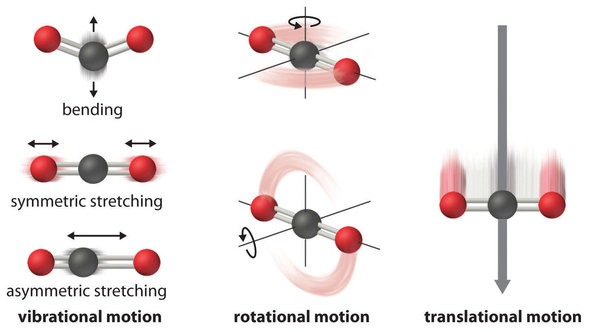
Figure 1.Molecular Motions. Vibrational, rotational, and translational motions of a carbon dioxide molecule are illustrated here. Only a perfectly ordered, crystalline substance at absolute zero would exhibit no molecular motion (classically; there will always be motion quantum mechanically) and have zero entropy. In practice, this is an unattainable ideal. Image used with permission (CC BY-SA-NC; anonymous).
The Third Law of Thermodynamics states that
- the entropy of any pure substance in thermodynamic equilibrium approaches zero as the temperature approaches zero (Kelvin), or conversely
- the temperature (Kelvin) of any pure substance in thermodynamic equilibrium approaches zero when the entropy approaches zero
The Third Law of Thermodynamics can mathematically be expressed as
lim ST→0 = 0 (1)whereS = entropy (J/K)T = absolute temperature (K)
At temperature absolute zero there is no thermal energy or heat. At temperature zero Kelvin the atoms in a pure crystalline substance are aligned perfectly and do not move. There is no entropy of mixing since the substance is pure.
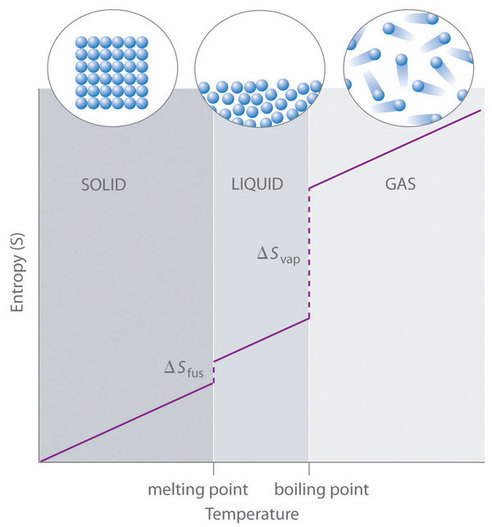
The absolute zero temperature is the reference point for determination entropy. Absolute entropy of a substance can be calculated from measured thermodynamic properties by integrating differential equations of state from absolute zero. For a gas this requires integrating through solid, liquid and gaseous phases.


No comments:
Post a Comment